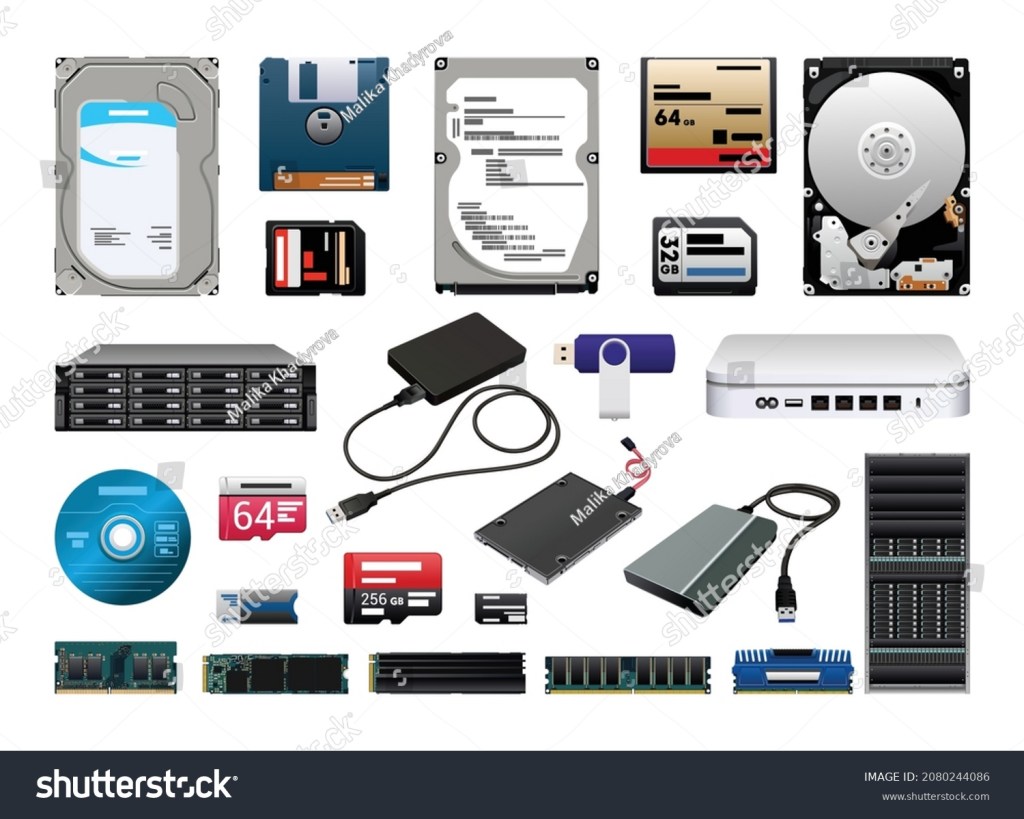
Storage devices are fundamental to modern technology, serving as the tools that save and preserve data in digital and analog forms. Whether it’s a personal photo, important documents, or vast databases powering the internet, these devices ensure information remains accessible when needed.
WHAT ARE STORAGE DEVICES?
A storage device is any hardware or technology designed to hold data for short or long-term use. They range from simple mechanical systems developed decades ago to highly advanced digital solutions used today.
HISTORICAL DEVELOPMENT
The evolution of storage devices began with early mechanical tools such as punch cards and paper tapes, which stored data physically. Over time, magnetic storage technologies like drums, tapes, and hard drives emerged, significantly increasing capacity and speed.
Optical storage later introduced discs read by lasers, while the recent rise of solid-state storage revolutionized speed and durability. Cloud storage has since added an entirely new dimension by enabling remote data access via the internet.
MAIN TYPES OF STORAGE DEVICES
Storage devices can be broadly categorized into several types:
MAGNETIC STORAGE
Uses magnetized surfaces to store information, including hard drives and magnetic tapes.
OPTICAL STORAGE
Stores data on discs readable by lasers, such as CDs, DVDs, and Blu-ray.
SOLID-STATE STORAGE
Employs electronic circuits without moving parts, including SSDs and flash drives.
CLOUD STORAGE
Data stored on remote servers accessed via the internet, enabling flexibility and sharing.
OTHER & EMERGING TYPES
Historical devices like punch cards and new technologies such as DNA data storage fall here.
HOW STORAGE DEVICES WORK
Different storage types encode and retain data differently — magnetically, optically, or electronically — but all are designed to reliably save and retrieve information.
THE IMPORTANCE OF STORAGE DEVICES
Storage devices enable the digital world by preserving data essential to computing, communication, and entertainment. Their continuous improvement drives technological progress.
LOOKING FORWARD
This article serves as an introduction. In future articles, we will explore each type in depth, uncovering how they work and their unique advantages.
Stay tuned for more detailed explorations on magnetic, optical, and solid-state storage devices!




 codersblog.com
Leave a comment