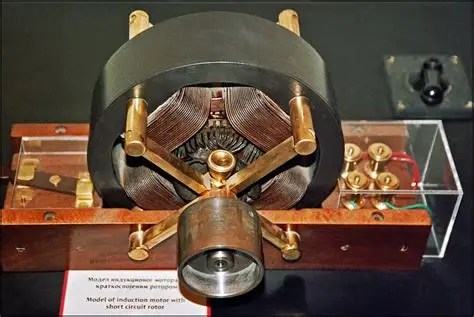
Welcome to Part Four of The Nikola Tesla Ultimate Guide. In this chapter, we explore one of Tesla’s most revolutionary and practical inventions — the Induction Motor. This is the machine that transformed electrical energy into mechanical power and became the beating heart of the modern industrial world. From factory equipment to electric vehicles, its design still drives our technology today.
THE ORIGIN OF THE INDUCTION MOTOR
In the late 1880s, the world faced a major challenge — how to efficiently convert electrical energy into continuous mechanical motion. Early motors required constant manual adjustment and used direct current (DC), which caused overheating and inefficiency. Tesla, through his deep understanding of alternating current (AC), realized there was a better way.
While working in New York, Tesla envisioned a motor that could run on alternating current and would require no brushes or commutators. In 1887, he built the first prototype of the AC Induction Motor, and in 1888, he patented it. His design used magnetic fields that rotated naturally, creating continuous motion without friction-heavy mechanical parts.
HOW THE INDUCTION MOTOR WORKS
Tesla’s Induction Motor operates on a simple but powerful principle — electromagnetic induction. This means that when alternating current passes through coils in the motor’s stator (the stationary part), it creates a rotating magnetic field. This field induces current in the rotor (the moving part), causing it to spin. The result is smooth, self-sustaining motion without direct electrical contact.
Here’s a breakdown of its key components:
- Stator: The fixed part containing coils powered by AC current.
- Rotor: The rotating cylinder that turns under the influence of the magnetic field.
- Magnetic Field: Created by alternating current, it rotates and pulls the rotor along.
- Slip: A small difference in speed between the magnetic field and the rotor that allows continuous torque.
What made Tesla’s design so brilliant was its simplicity and durability. It eliminated sparks, reduced maintenance, and provided smooth, reliable motion — a major improvement over DC motors of the time.
THE TESLA-WESTINGHOUSE PARTNERSHIP
After developing his motor, Tesla joined forces with industrialist George Westinghouse, who saw the potential of alternating current. Westinghouse bought Tesla’s patents for $60,000 in cash and stock — and offered him a royalty for every horsepower generated by his motors. Together, they pushed AC power into homes, cities, and factories across America.
This partnership led to one of the greatest technological achievements of the 19th century — the electrification of the world using Tesla’s AC system and induction motors. The success of the 1893 Chicago World’s Fair and the Niagara Falls Power Project proved that alternating current and Tesla’s motor design were the future.
IMPACT ON THE MODERN WORLD
The Induction Motor changed everything. It became the foundation for:
- Industrial machines and conveyor systems
- Electric fans, pumps, and household appliances
- Modern electric vehicles and trains
- HVAC systems and large-scale generators
Today, nearly every rotating machine you encounter — from washing machines to electric cars — runs on Tesla’s principle of induction. Even Tesla Motors, the car company named in his honor, uses advanced AC induction motors inspired by his original designs.
THE SCIENCE BEHIND THE MAGIC
One of Tesla’s most important discoveries behind the induction motor was the concept of the rotating magnetic field. He demonstrated that when two or more alternating currents are out of phase, they create a field that appears to rotate. This invisible motion drives the rotor, producing mechanical energy from electrical energy — with almost no energy loss.
In essence, the induction motor works because the magnetic field “drags” the rotor around without physical contact. It’s like an invisible hand spinning a wheel using pure electromagnetism — a concept that still amazes engineers today.
HISTORICAL SIGNIFICANCE
The induction motor marked the beginning of the Second Industrial Revolution. It allowed machines to operate continuously and efficiently, leading to faster production, mass manufacturing, and urban growth. It also helped prove that Tesla’s alternating current was superior to Edison’s direct current — a victory in the legendary War of Currents.
More than a century later, Tesla’s induction motor remains the standard for efficiency and reliability in electric engineering. It’s one of the few inventions from the 19th century still in daily use worldwide — a true testament to his genius.
LOOKING AHEAD
Tesla’s induction motor wasn’t just an invention; it was a revolution in motion. It transformed how humanity used energy and reshaped the modern world. In the next part of The Nikola Tesla Ultimate Guide, we’ll explore one of Tesla’s most ambitious projects — the Wardenclyffe Tower, his dream of transmitting wireless energy across the planet.


 codersblog.com
Leave a comment